Understanding Counter Rotation: Surfing, Skiing, and Snowboarding Guide
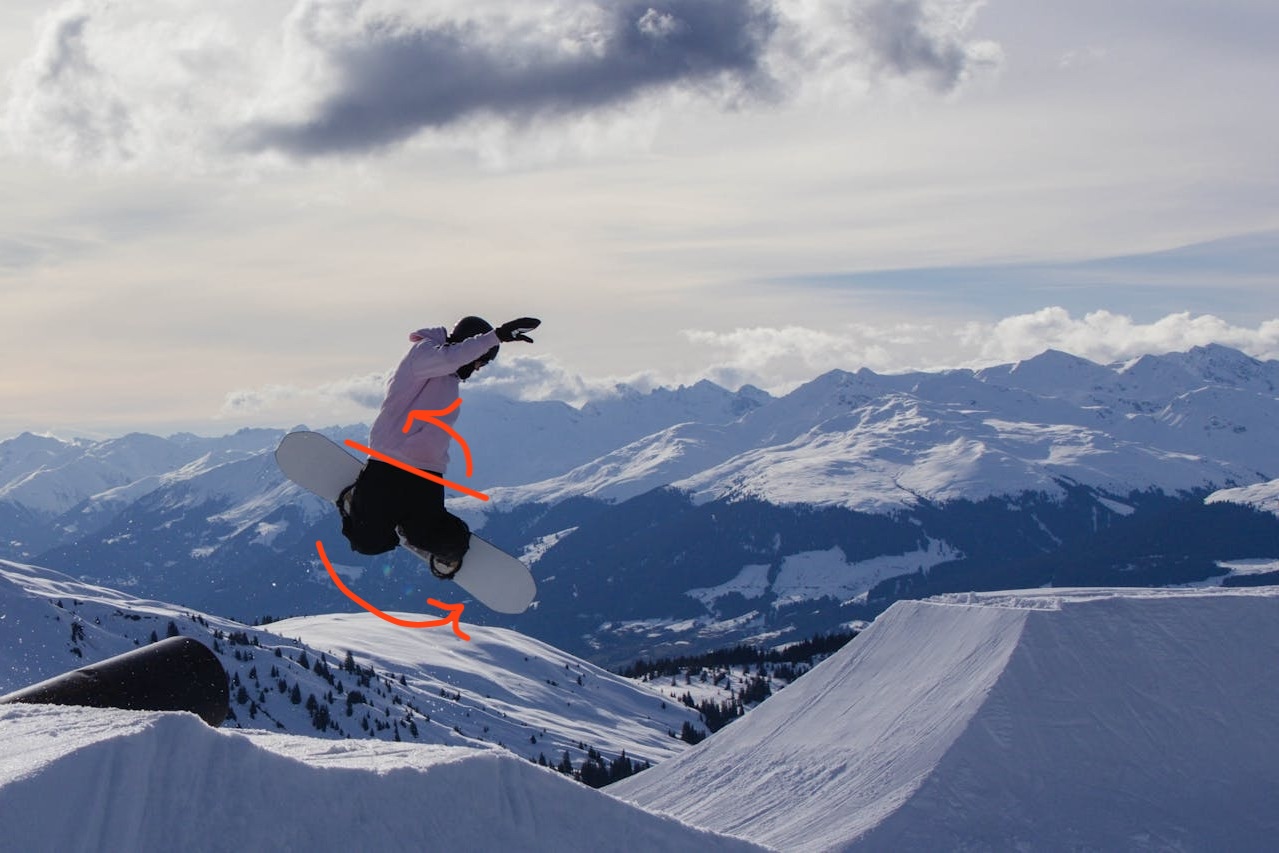
This article will be a comprehensive overview of understanding and utilizing counter rotation in the sports of surfing, skiing, and snowboarding.
The chapters and topics are as follows;
Introduction
1: What is Counter Rotation? Normal Rotation?
2: Advanced Examples of Counter Rotation
3: Basic Stances Using Counter Rotation While Riding
4: Other Examples of Useful Counter Rotation
5: Concluding Notes on Counter Rotation
6: Extra Information Over Counter Rotation
Introduction
When it comes to becoming great at surfing, skiing, or snowboarding, it is vital to understand counter-rotation. This article aims to provide a helpful guide at understanding what counter rotation is, how to utilize it, and some examples of it in use.
I created this extensive article, because the more I researched, and aimed at understanding counter-rotation, the less I found it to be a major topic of discussion, and the fantastic things you can achieve by utilizing it remain to be under discussed.
I think researching all three of these sports, including perhaps gymnastics, skating, and other aerial-type sports, will help you understand counter rotation, and make it more implementable in your sports. But, today I will be focusing on surfing, skiing, and snowboarding, as they are the sports that I find the most fun.
I really hope this article is beneficial to you, as researching this topic was beneficial to my understanding of these sports. With all that said, please take my words with a grain of salt, as I am certainly not a professional in these sports. I may stand corrected on some of these topics in the future, as I learn more, and test these hypotheses and ideas. With that said, I think this article will be highly beneficial to those who are willing to learn about this topic.
Chapter 1: What is Counter Rotation?
Counter Rotation
Counter Rotation is when two forces, move in opposite directions simultaneously. They are in a position of counter rotation from each other. Theoretically, using Newton’s Third Law, the law of action and reaction, as well as the Conservation of Angular Momentum, the law where a person spins faster when they tuck their arms in, if you place two equal forces going in opposite directions, they cancel each other out. Just imagine, two balls of the same weight, hitting each other, they force each other to stop. I suppose that is just Newton’s Third Law, but this article will go into angular momentum with some examples.
Let’s apply this to the human body, by starting with an example. This example will include you, so you can intuitively feel and understand this example, and counter rotation.
Stand up. Put your feet together. Jump up. After you jump, without adding rotation before you do the jump, try and do a 180, without moving your upper body. So jump, then in mid air, try to rotate. Almost impossible right? Your hips, can’t produce said momentum to fully do a 180.
Now, do the same thing, although this time, place your arms to the left side of your body, and when you jump, try to do the 180 to the left side where your arms are. When you do, I bet you will throw your arms in the opposite direction, to the right, of your intended turning direction, which allows you to do a 180. Here, you used counter rotation.
You moved your hips and legs to the left, while your upper body rotated to the right, in the opposite direction.
This video doesn’t example show the 180 we are going for, but rather a 90. But it shows counter rotation in action. Although its very basic example of it.
To the human extent, it seems like you can really only utilize counter rotation to about 270 degrees. Well, that is, unless you are extremely flexible and can contort your body 360 degrees, which I highly doubt.
Normal Rotation?
Normal rotation can be achieved on the ground. Its charging up and moving your whole body, both lower body and upper body in the same direction.
To see it in action. Stand up again. Twist your body to the farthest right you can, and put your arms in that direction too. Then twist everything in the opposite direction and jump. That is normal rotation.
Chapter 2: What Can You Achieve Utilizing Counter Rotation
Before we apply counter rotation to our favorite action sports, let’s look at some fantastic examples to understand how someone can utilize counter rotation in these sports. These examples, will be more emphasizing the ultimate ends and the potential of counter rotation, rather than the simpler applications that help you in everyday situations. But, they are hype, and may make you more intrigued about what counter rotation can achieve in these sports.
Example 1: Skiing
This example is going to be a way far outside of our comfort, nor possibilities of what we will be doing within in our lifetime of skiing, but nevertheless, it’s an interesting perspective on what counter rotation can achieve in skiing.
Here with have a Faction Ski’s Film, featuring Matej Svancer in a couple clips. In this one, for ease of explanation, he is doing a side flip late-switch 180. The 180 in this flip, is achieved through counter rotation. Watch this split-second clip below, and then I will discuss it with a couple of photos showcasing the direction his upper and lower body is in.
Ok, so coming into this jump, you can see he begins to lean to the left to start a normal rotational flip. His torso, upper body, is facing straight.
As he begins to get air, his torso is charged in a position counter to his hips.
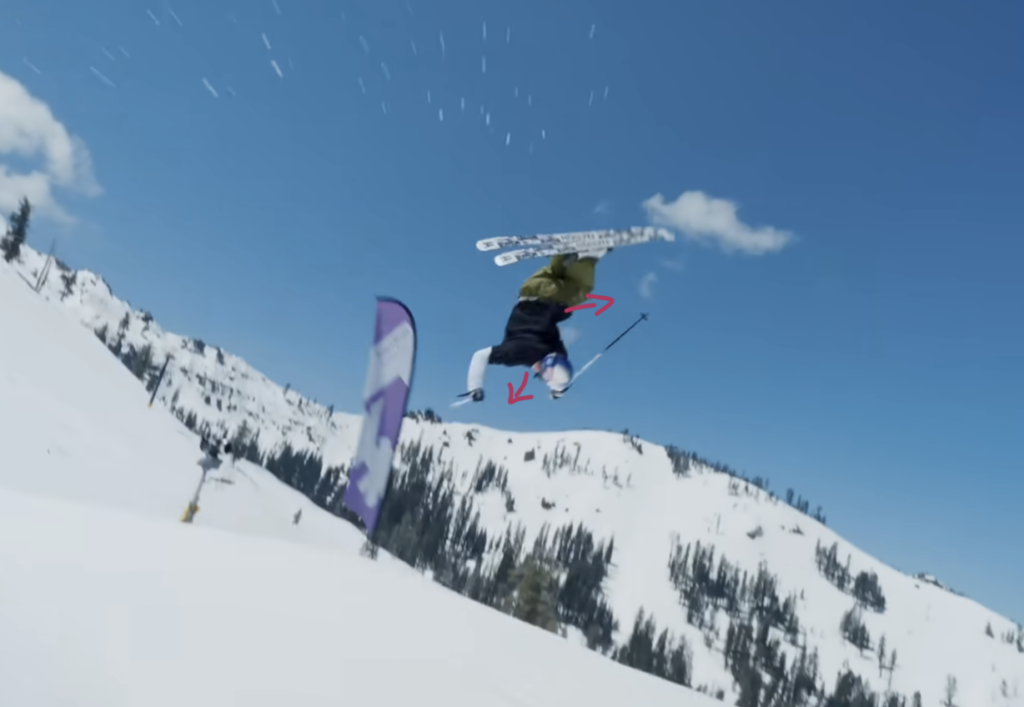
His torso and legs are still in a counter position. Apologies for explaining the picture below, as it was hard to depict with two dimensional arrows. But, look how is looking down with his torso, and his hip is facing a bit upward, in the opposite direction.
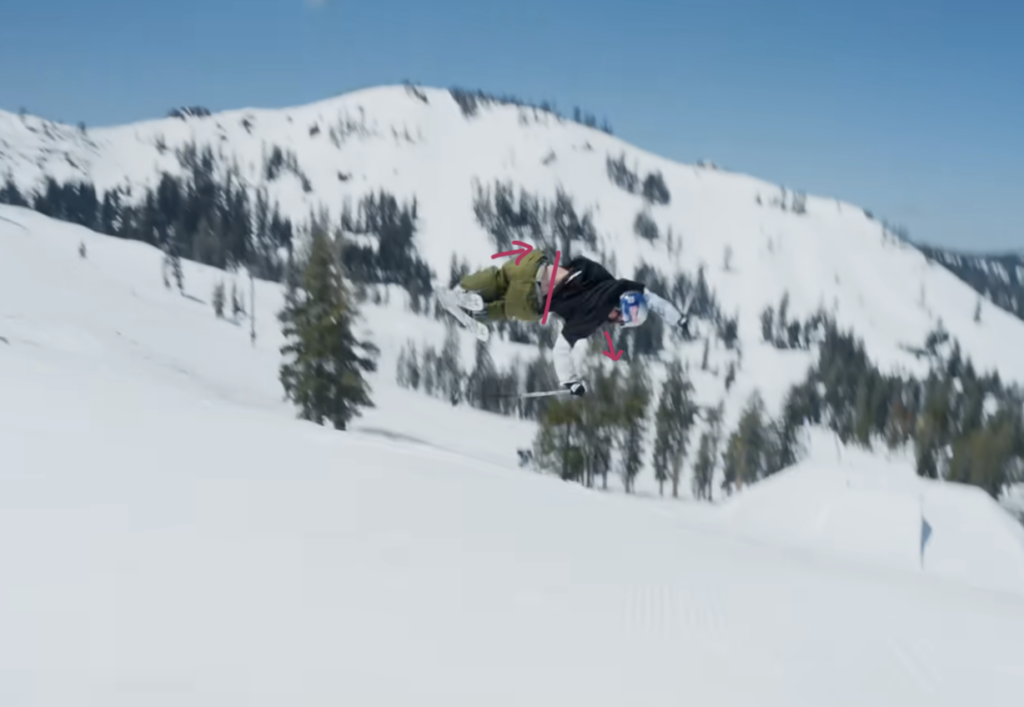
He then pulls his hips, and torso, in the opposite directions, thereby engaging counter rotation, and allowing this late switch 180 occur.
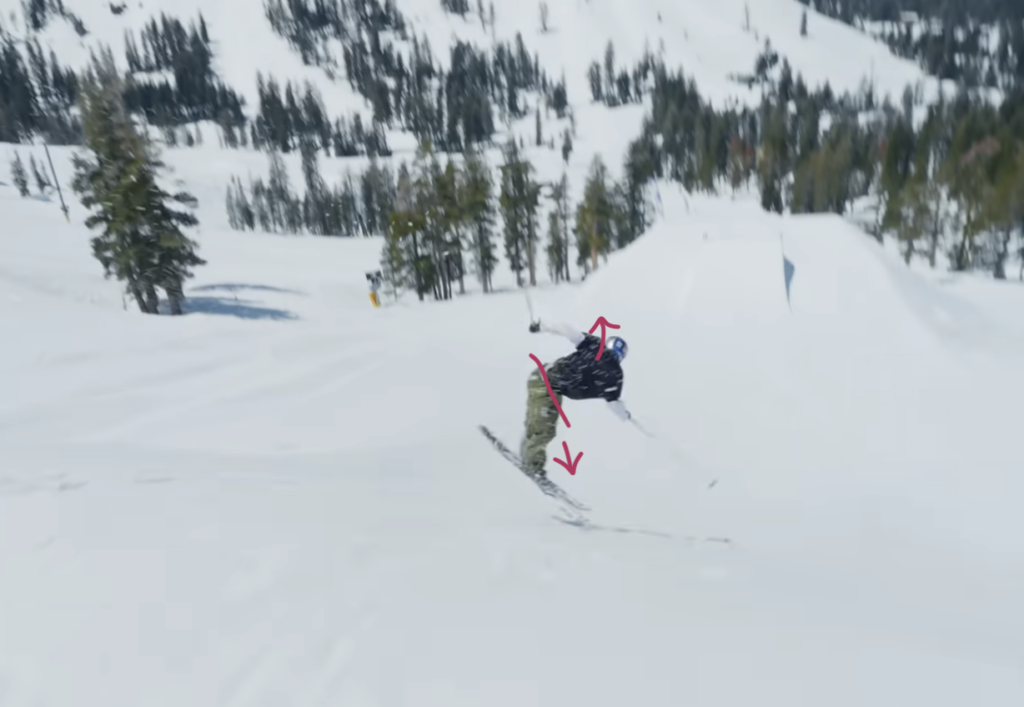
Lastly, you can see that his torso, and legs are now in a juxtaposition of opposition. His torso faces down the slope, while his hips and lower body face upward.
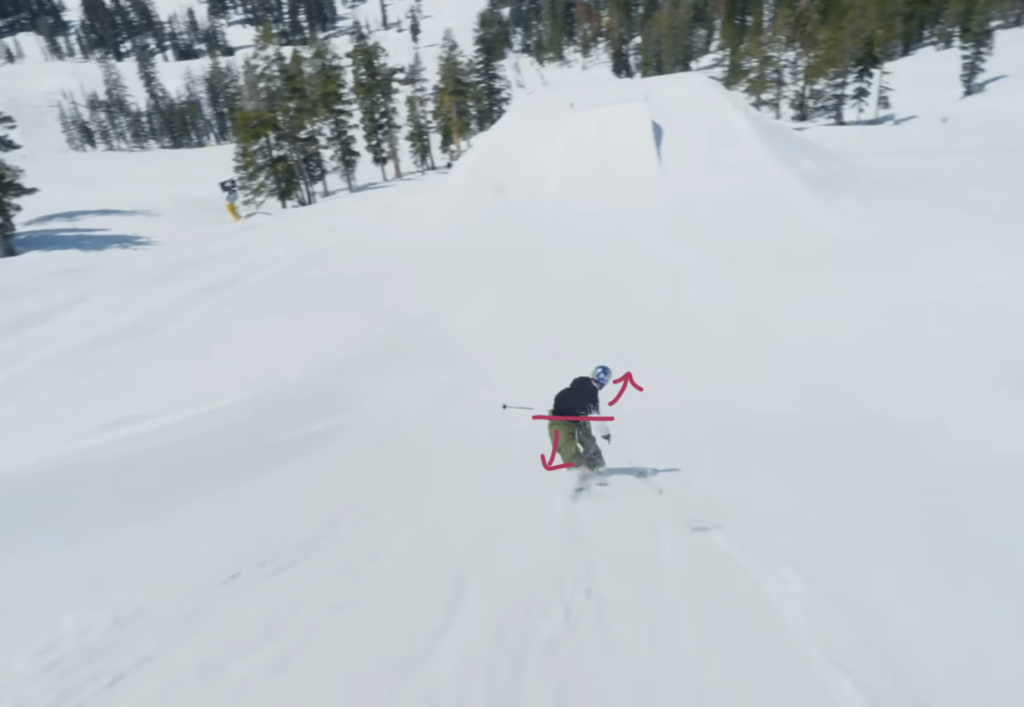
Overall, with the power of counter rotation, one is capable of achieving a late 180 with skiing, your body is positioned correctly with the the start of your jump.
Example 2: Surfing
This is a perfect example of counter rotation in surfing. Sometimes, you do not have the opportunity to prepare for a beautiful hack at the wave, with a full body rotation and twisting.
Rather, you must quickly, attack it after a previous section is finished. Here you can utilize counter rotation to make that possible. This example is more focused on arm position, although the hips and torso do play a part in it.
Afterall, we are examining John John Florence, the world’s best surfer, in my opinion, doing this very motion during a surf contest. After hucking a sweet air John John, goes into his next turn and does this;
To begin is approach into the turn is a typical surfer motion. Torso over the heels, leaning into it. Notice how his right arm is charging up to do a typical turn by pulling it far behind his body.
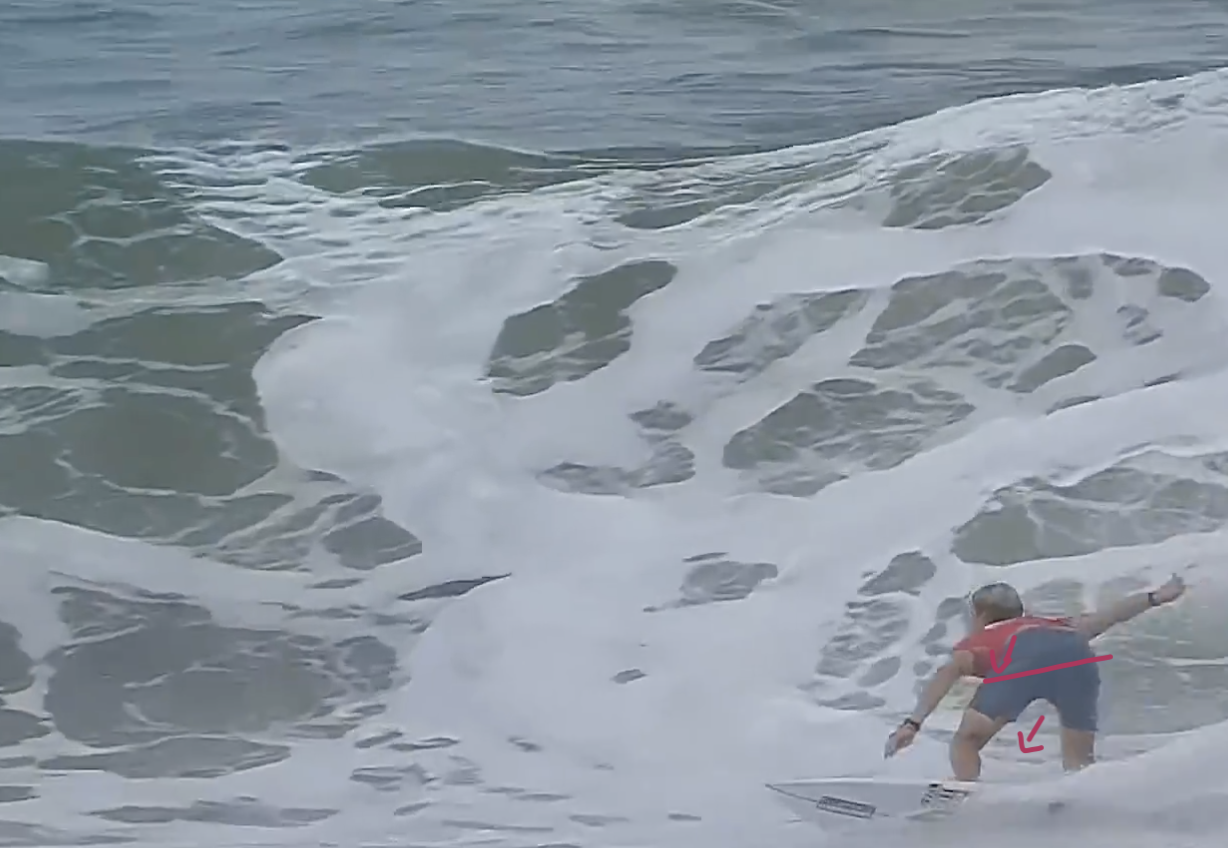
But then notice his right arm in the following picture. He does not throw it across his body as a normal large turn would be had. He brings it up to his body, without a throw.
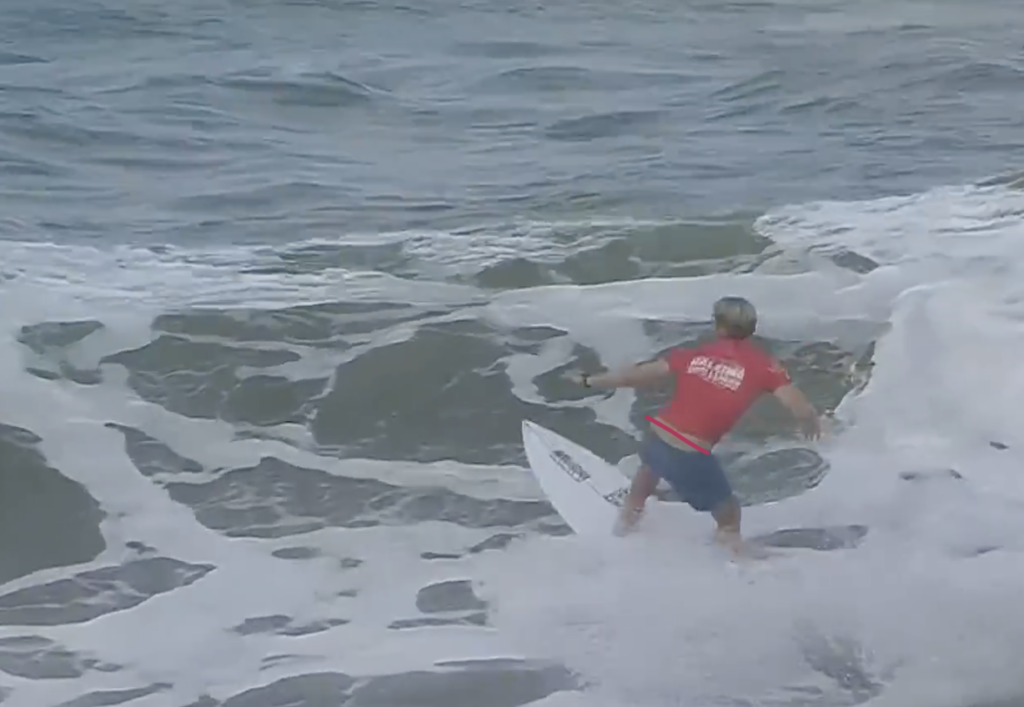
He then lays his right arm deep into the water, brings his left arm across his body towards his right arm, and lets his hip rotate leftward.
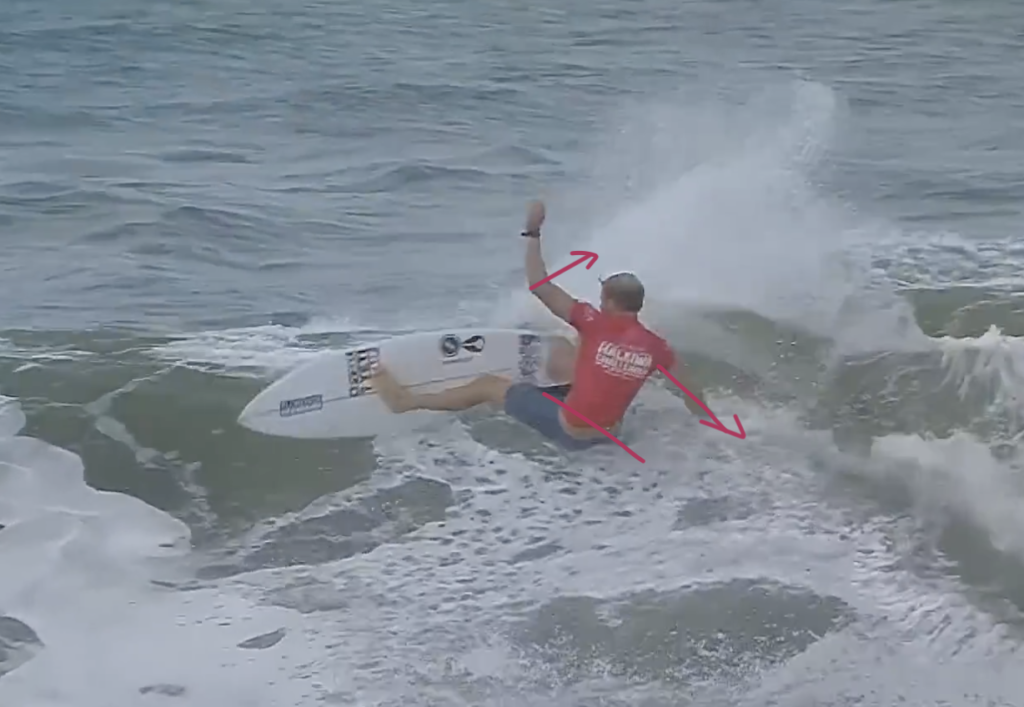
After doing that motion, you can see in the following photo which directions his torso and hips are facing.
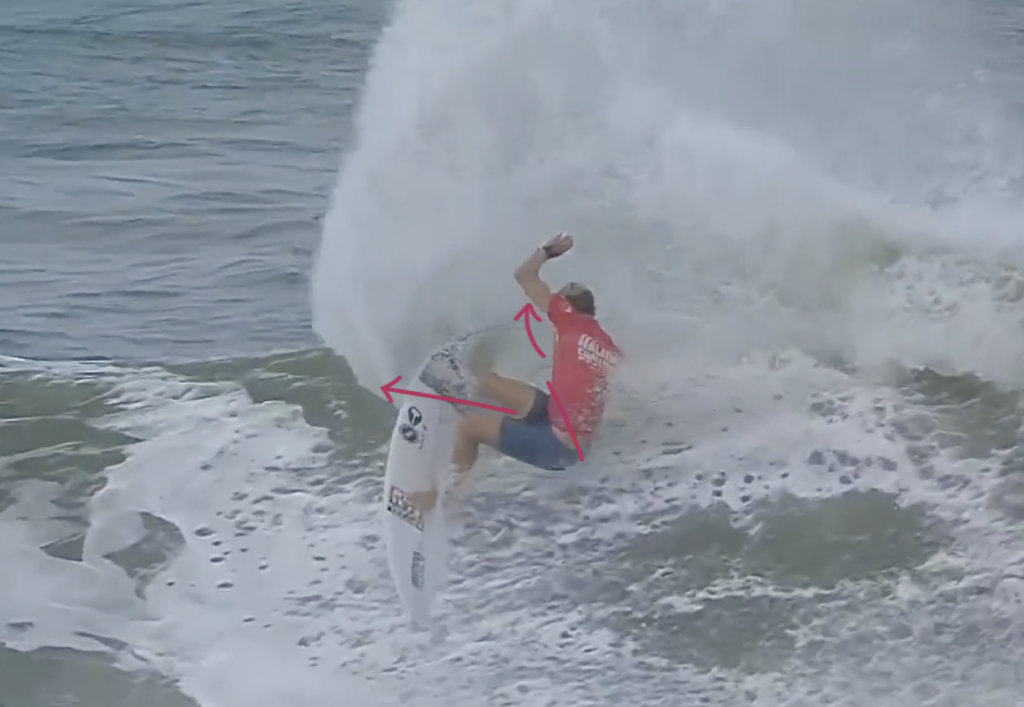
Look at that spray though! The majority of this turn was achieved with counter rotation. The hips were rotation to the left the whole time, but the power came from the arms and the upper torso, working against those hips, thereby increasing the power!
Example 3: Snowboarding
This example comes from the famous snowboarder, Arthur Longo. In his fantastic video Side Hit Euphoria – Chapter 3. Please watch this clip as below as it is a perfect example of counter rotation and what can be achieved with it.
Firstly, notice as he comes into the jump, he T’s up his upper body towards his landing. His feet are stationary, and will provide no charged-up rotation in his jump. As he jumps, his torso and hips are facing two different directions, as depicted in the photo below.
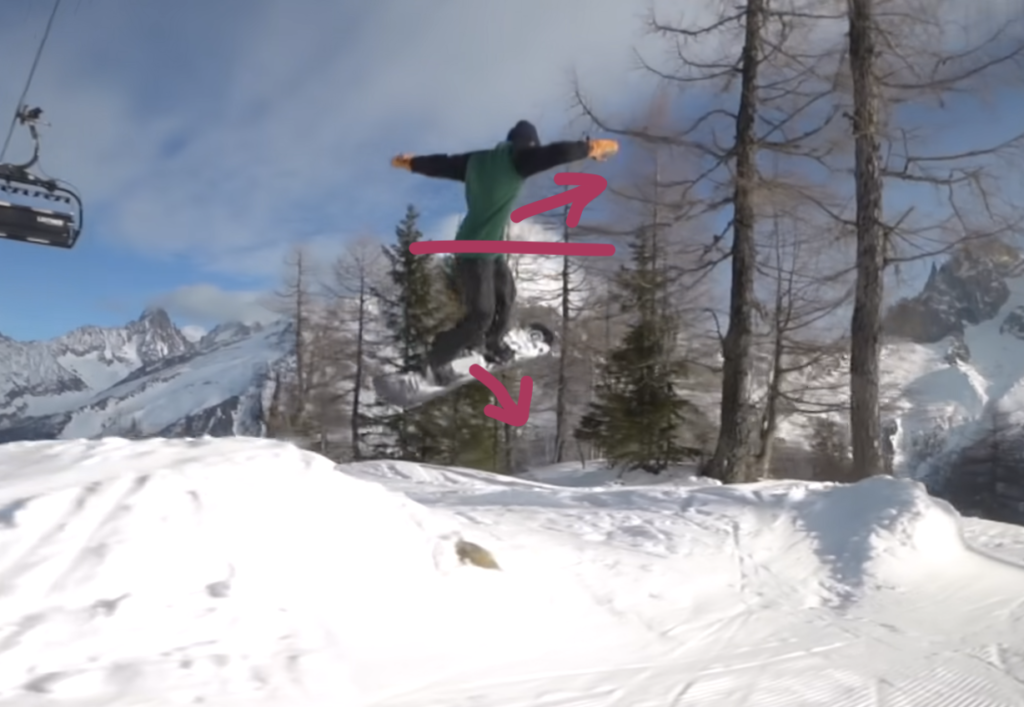
As he progresses in air, he pulls in his left arm to the right direction, and pulls his right knee up towards his chest, thereby enacting counter rotation. Ultimately he ends up with his torso, and his hip, in the opposite direction than where they began the jump on.
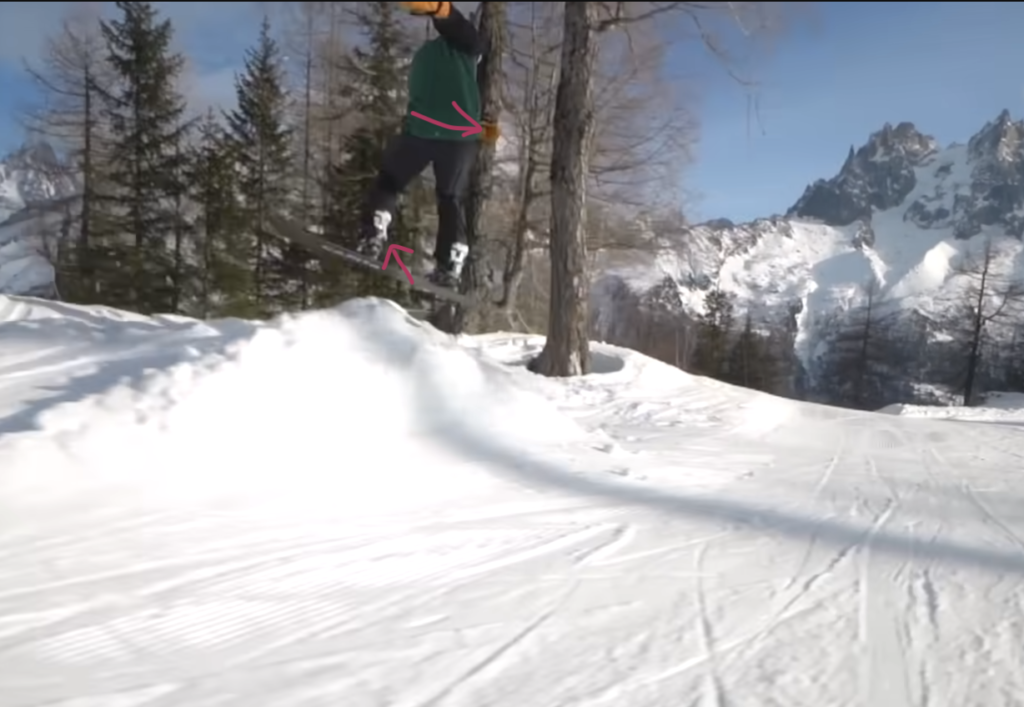
As you can see. His arms are further to the right, while his feet are pointed in the opposite direction.
So, the potential for a mid-air, 180, is perfectly possible with counter rotation.
The potential of counter rotation.
As you can see, the potential for counter rotation in sports such as surfing, skiing, and snowboarding can assist a ton in maneuvers. Typically, ones in the air, although land maneuvers are also potentially beneficial to this. Lets dive into some basics know with typical stances, that assist in riding in each of these sports, holding your rails, and preparing yourself for more advanced maneuvers.
Chapter 3: Basic Stances Using Counter Rotation While Riding
All three of these sports have a standard riding position that supports stability, edge control, and preparation for maneuvers.
The main thing you will be looking at in each of these examples, is using the counter rotation, of lower body to upper body, to maintain a good center of gravity over your board.
Skiing stands apart from surfing and snowboarding in these examples, although the mechanics are interesting.
Snowboarding Counter Rotation Stance
I would love to explain myself, the difference between counter rotation snowboard turning and regular turning, more carving, although there are some fantastic examples online of it on a video.
Now lets focus on maintaining your balance while turning. Take these photos for example.
The first one here is from James Cherry’s Youtube Video about snowboard carving. Notice how his body weight is broken at the knees and he is maintaining a center of gravity over the board.
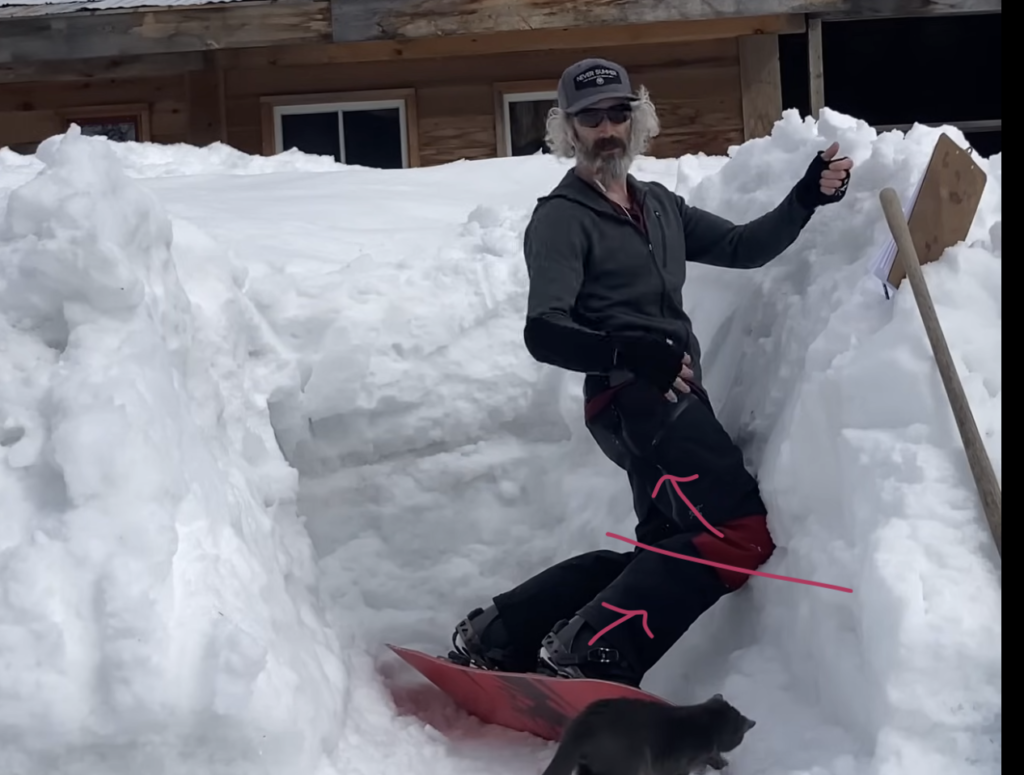
Or, take a look at this photo of Ryan Knapton, and his carving technique. Knees are bend, and the back and rest of the body above the knees is attempting to work itself in the opposite direction of the lower than knees direction. Almost like a soul arch.
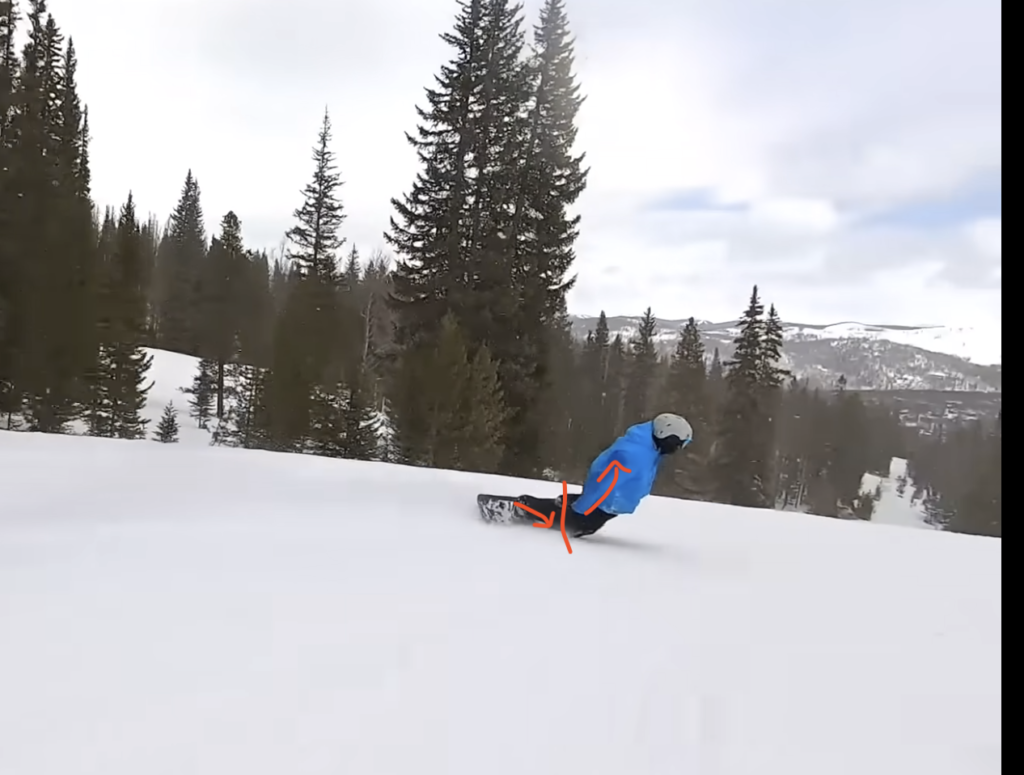
This one features Ryan, where his knees and hips are pushed out backwards, but his upper torso is fighting in the opposite direction.
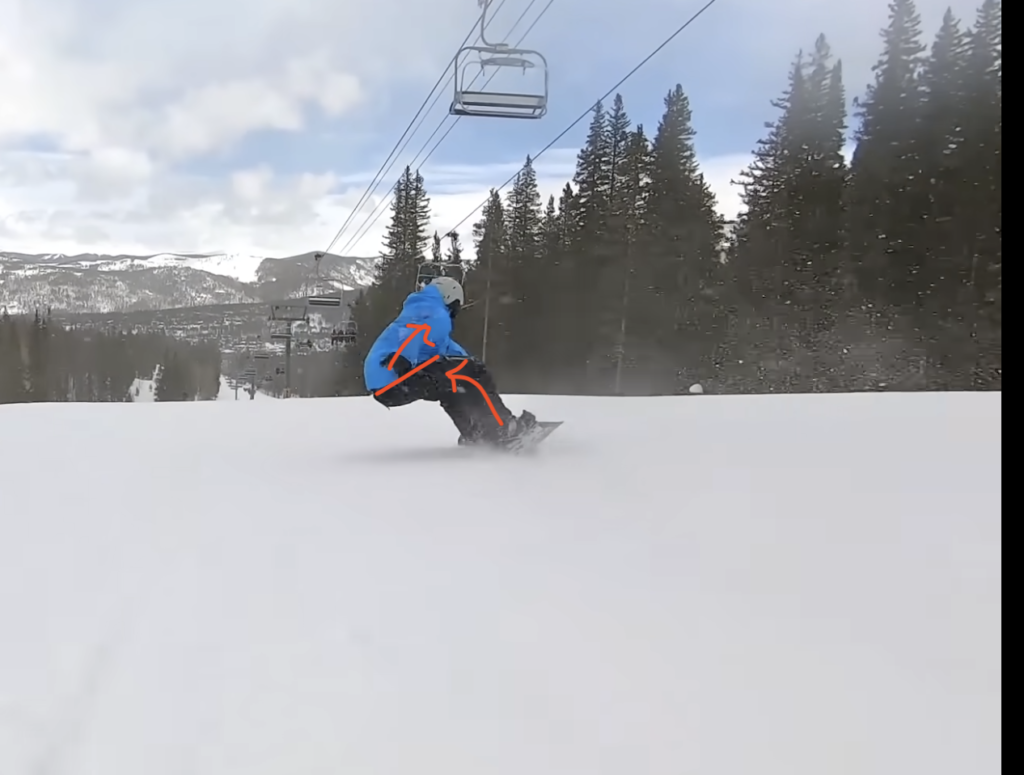
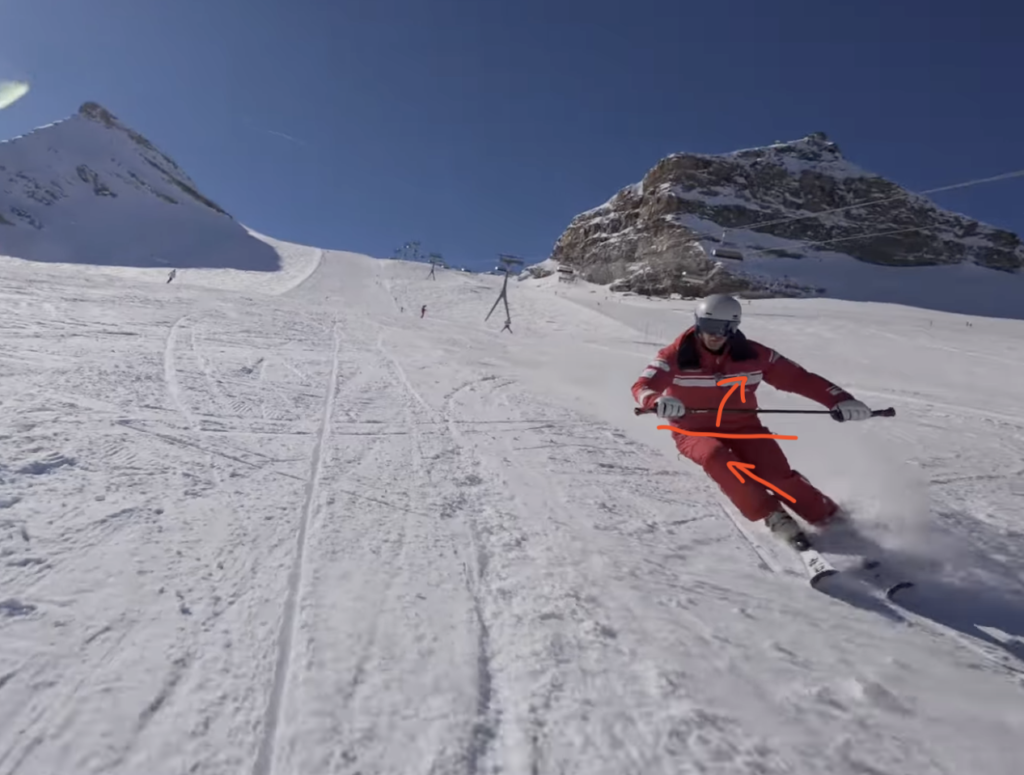
These three examples showcase counter rotation when maintaining balance on your snowboard. This isn’t a stationary sport; it is not counterbalancing two objects, its using your motion to achieve a state of counter balance. Pushing your hips back, while bending your torso forward, works in a counter rotation dynamic. Thereby, equilibrating them, and achieving a center of balance over your board. If you were to only lean, bend your knees, or push your butt out, you would most likely fall in one direction or the other. You need to use the other part of your body, to counter rotate, and achieve an equilibrium.
Skiing Counter Rotation Stance
While skiing, counter rotation is used to maintain balance in your carves. Counter balance while skiing is important as it allows you to gain more edge control, better center of gravity, and increases energy transfer when youare moving from one edge carve to the next edge carve. The photo below is taken from the Swiss Snow Demo Team;
Surfing Counter Rotation Stance
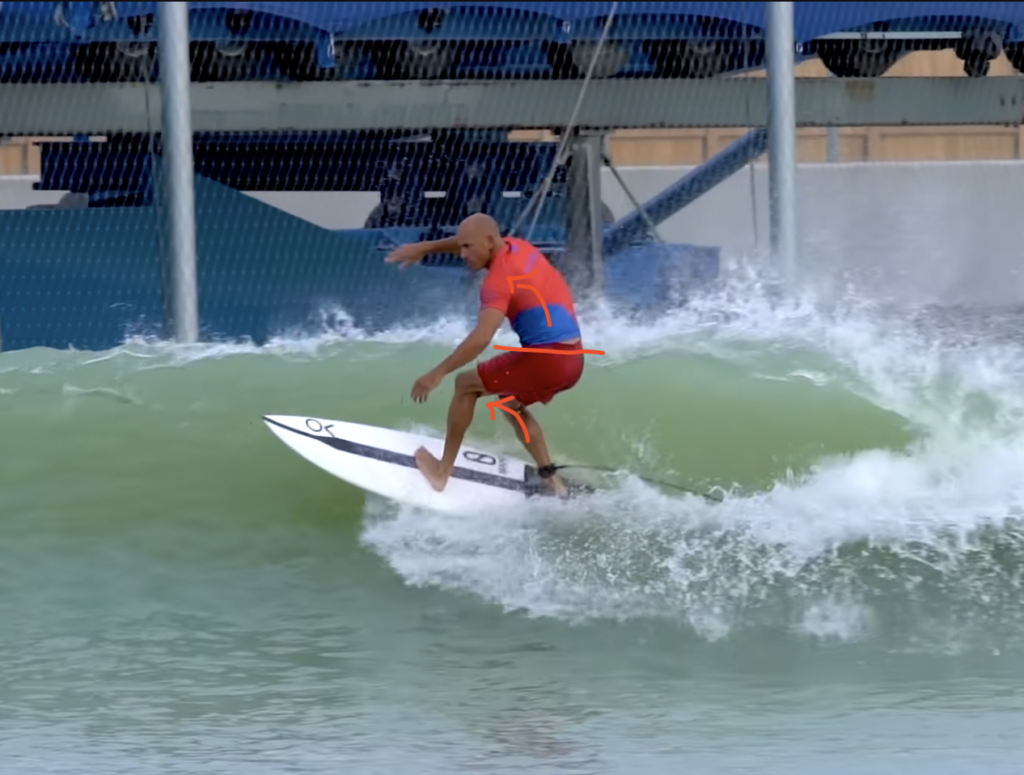
The surfing stance really doesn’t take too much of the concept of counter rotation into play, besides maintaining a center of gravity over your board. If I come across a video or photo that displays a proper moment of counter rotation then I will loop back around and update this, but for now, this photo of Kelly Slater suffices for a surfing stance that has stability and a good center of gravity.
 Final Notes on Basic Stances
I would like to reiterate that all of these stances do in some form use counterbalance to maintain a solid basic stance position.
To reach this counter balance, one has to use counter rotation, typically of bending the knees, pushing the hips backward, while bringing the torso town.
Chapter 4: Other Examples of Useful Counter Rotation
The other main useful note of counter rotation is finishing spins. Sometimes using regular rotation makes you continue your spin, while counter rotation allows you to achieve an additional X amount of spin, without continuing the rotational speed thereafter. As, once again, the counter rotation is only proportional to the amount of counter reaction you put into the rotation.
Using Counter Rotation to do a Chop Hop
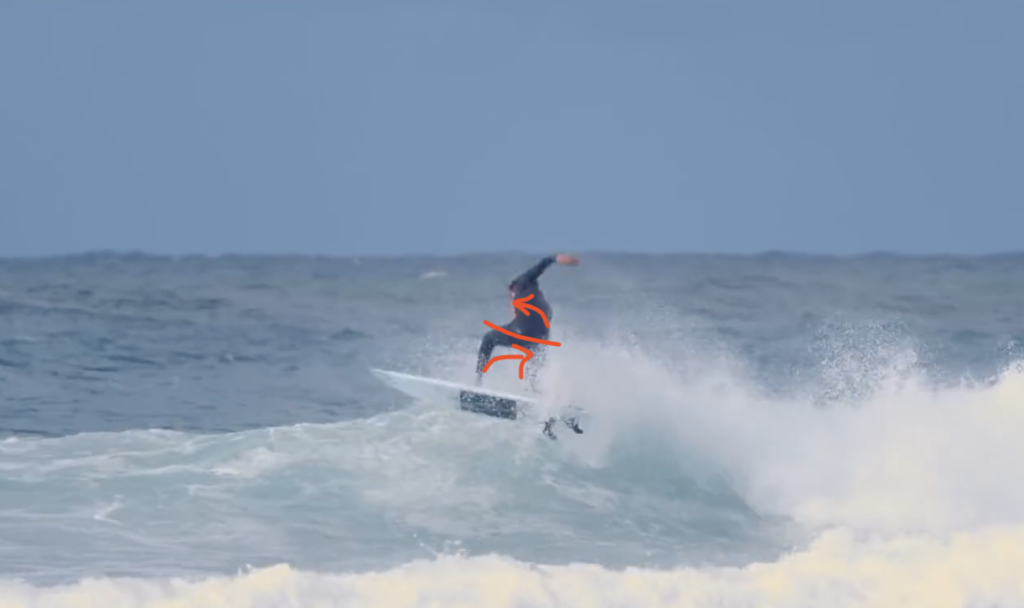
Take a look at this short video of Dakoda Walters trying to do as many Chop-Hops on a wave as he can. To make sure your watching the same chop hop, it is the third one on the wave, and he ultimately falls.
Please note the rotation of his upper torso and lower hips. He begins by rotating his whole body the same direction, but ultimately brings back his right arm, thereby leading his torso all to the left direction.
Using Counter Rotation to do a Shifty
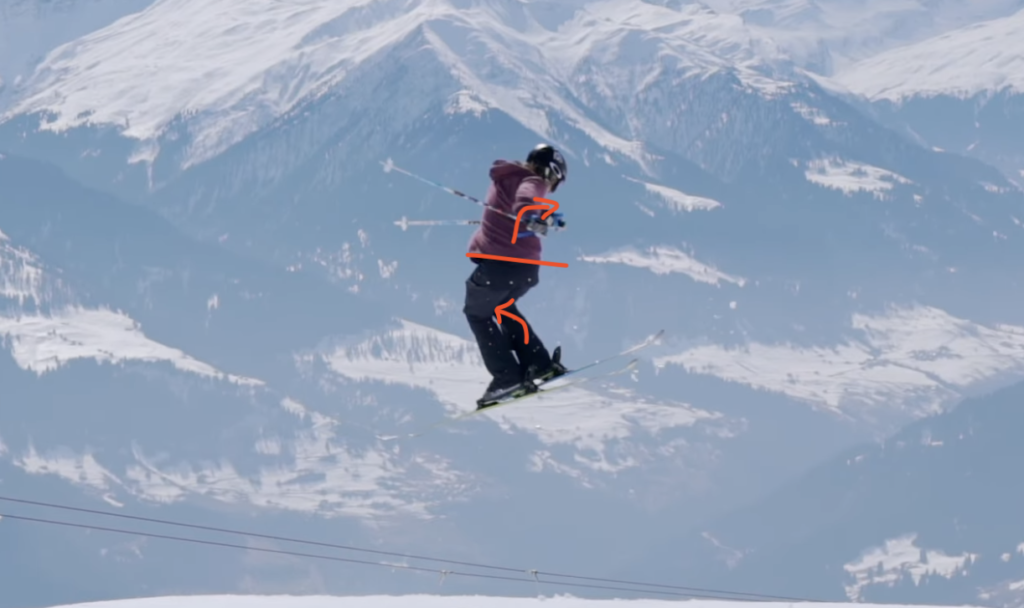
A good example of the perfect ski and snowboard trick is the shifty. Take this video below of how this shifty looks, and see that his upper body and lower body are disconnected and moving in opposite directions.
A freeze frame of this ski trick will showcase the movement of upper and lower body.
360’s and More Using Counter Rotation
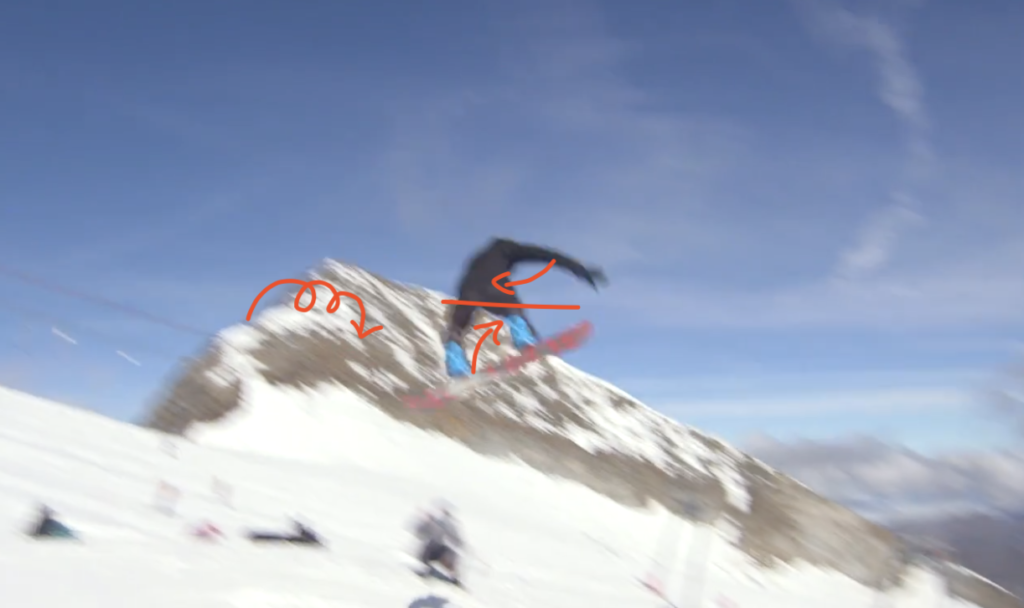
The start of this video, which I recommend watching as its about rotation and counter rotation, shows a perfect example of someone using counter rotation in conjunction with rotation to achieve a multi-spin trick, while landing without further rotational force.
This athlete is doing the trick with spinning to the right, but at the last 180 they pull their right arm back towards the left, finalizing a 180 but removing any further rotation force, thereby making it easy for them to land straight and continue forward.
Chapter 5: Concluding Notes on Counter Rotation
There is so much to learn about counter rotation in surfing, skiing, snowboarding, as well as other action sports. Once again, counter rotation is disconnecting two parts of your body, typically your upper and lower body, to create oppositional forces, that allow you to counter rotate them. Upper torso goes left, lower body goes right.
I hope that this article helped you understand counter rotation, and maybe how you can implement it into your everyday sessions.
Chapter 6: Extra Information Over Counter Rotation
Obviously, the knowledge goes on, so I wanted to link some videos below. I will embed them for ease of watching and so on
Tramp Tricks counter Rotation